 Proven Sudoku
XYZ-Wing
Also called Extended XY-Wing.
New to this shorthand? How to read a sudoku grid explains r4c7, houses, candidates and the rest.
What it means
Like the XY-Wing, but the middle square has three numbers instead of two. That means the middle one can also be the shared number. So a square only loses the number if it sees all three, not just the two ends.
The exact rule, for stronger players
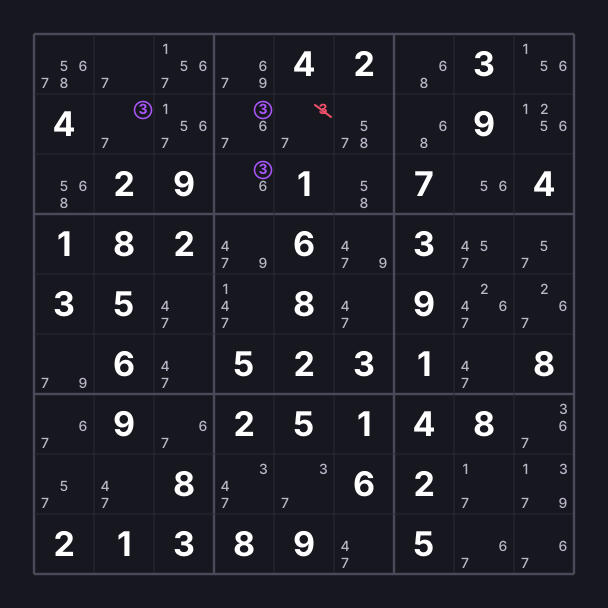
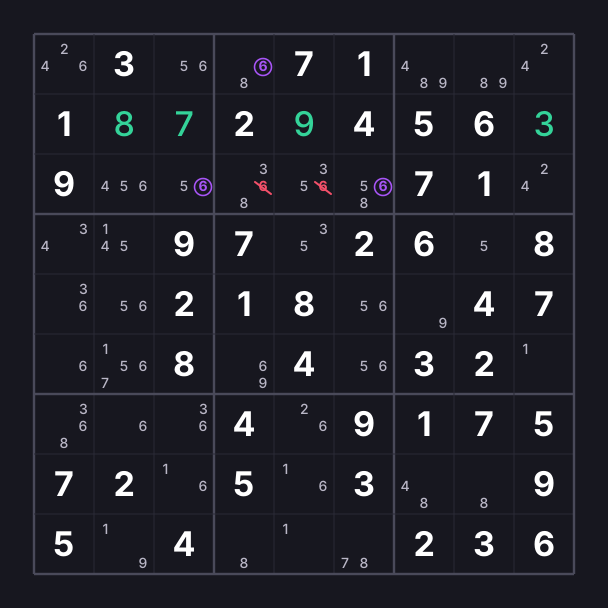
The rule, stated exactly: A pivot with candidates {x,y,z} and two pincers {x,z} and {y,z}, both seeing the pivot. Then z is eliminated from every cell seeing all three.
What it removes: Remove z from cells seeing the pivot and both pincers, which in practice means cells in the shared box and line.
Why it works: One of the three cells holds z, because the pivot is x, y, or z, and in the first two cases a pincer is forced to z. So z is in the set, and any cell seeing all three is excluded.
Worked examples
These come from real Proven Sudoku boards. Nobody drew them by hand to make the pattern look neat. Each one is checked first, so the board is one you could really meet, the pattern is really there, and every digit it rules out is really wrong.
Learn these first
- XY-WingThree squares, each with two numbers left.
Related wings
- Bent Naked SubsetA group of squares bent across two rows, columns or boxes.
- Letter-named wings (M, S, L, H, Split, Hybrid, Local)Short chains that people gave letters to.
- Remote PairsA string of squares that all hold the same two numbers, each one linked to the next.
- VWXYZ-WingThe same idea stretched to five squares and five numbers.
- W-WingTwo squares far apart hold the same two numbers.
How often does it come up?
Our rough estimate: less common than the XY-Wing, and the elimination set is smaller because the target must see three cells.