 Proven Sudoku
Unique Rectangle Type 4
Also called UR Type 4, UR4.
New to this shorthand? How to read a sudoku grid explains r4c7, houses, candidates and the rest.
What it means
Two corners hold only the pair. In the row or box holding the other two, one of the pair has only those two homes. So one of them takes it. The other number of the pair is then squeezed out of both.
The exact rule, for stronger players
The rule, stated exactly: Two cells hold exactly {x,y}, the other two hold {x,y} plus extras, and in the house containing the two cells with extras one of x or y is confined to those two cells. Then the other of x or y is eliminated from both.
What it removes: Remove the non-locked digit from both cells with extras.
Why it works: If digit x is locked to the two cells in that house, one of them is x. If the other were y, the rectangle would complete, so y cannot appear in either. This technique is only valid when the puzzle is known to have exactly one solution. It is not a deduction about Sudoku rules, it is a deduction about the puzzle setter's promise. On a grid with multiple solutions it produces wrong answers.
Worked examples
These come from real Proven Sudoku boards. Nobody drew them by hand to make the pattern look neat. Each one is checked first, so the board is one you could really meet, the pattern is really there, and every digit it rules out is really wrong.
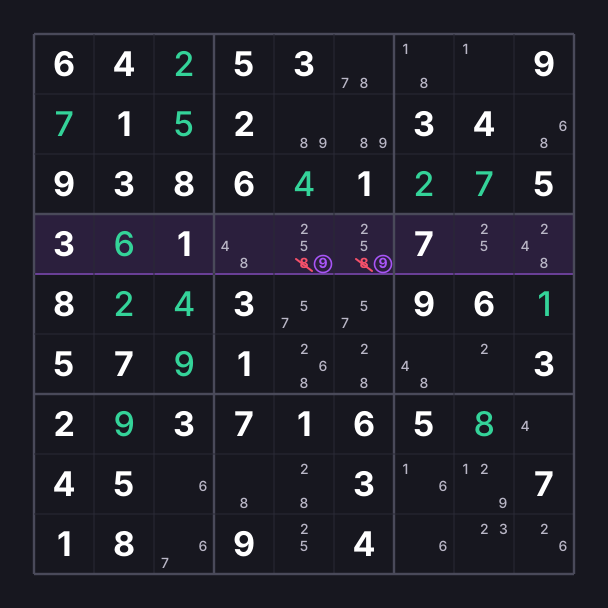
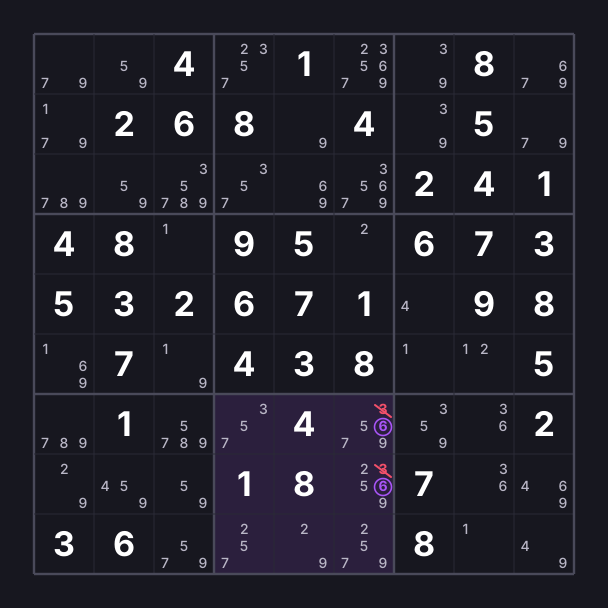
Learn these first
- Unique Rectangle Type 2Two corners hold only the pair.
- Hidden PairTwo digits in one group can only go in the same two squares.
Related uniqueness
- Unique Rectangle Type 5Like Type 2, but the extra number sits in corners that sit across from each other rather than side by side.
- Unique Rectangle Type 6Like Type 4, but the two numbers form an X across the rectangle instead of sitting along one side.
- Unique Rectangle with Missing CandidatesA rectangle where one corner has already lost one of the two numbers.
- Avoidable RectangleFour squares can form a rectangle across two boxes.
- Avoidable Rectangle Type 1Three corners of a rectangle were worked out by you, not printed in the puzzle.
How often does it come up?
Our rough estimate: moderately common.