 Proven Sudoku
Techniques / Single-digit patterns
Turbot Fish
Also called Single-digit chain of length 4, Turbot.
New to this shorthand? How to read a sudoku grid explains r4c7, houses, candidates and the rest.
What it means
Pick one digit. Find two pairs of squares where that digit has only two homes. Link the pairs together. Then the two far ends cannot both be empty of the digit. One of them has it. Any square that can see both ends loses the digit.
The exact rule, for stronger players
The rule, stated exactly: For digit d, a chain of four nodes alternating strong, weak, strong link. If the two endpoints see a common cell, d is eliminated there.
What it removes: Remove d from every cell that sees both endpoints.
Why it works: Take the two endpoints. If the first is false, the strong link forces its partner true, the weak link forces the next false, and the second strong link forces the far endpoint true. So at least one endpoint holds d, and any cell seeing both cannot.
Worked examples
These come from real Proven Sudoku boards. Nobody drew them by hand to make the pattern look neat. Each one is checked first, so the board is one you could really meet, the pattern is really there, and every digit it rules out is really wrong.
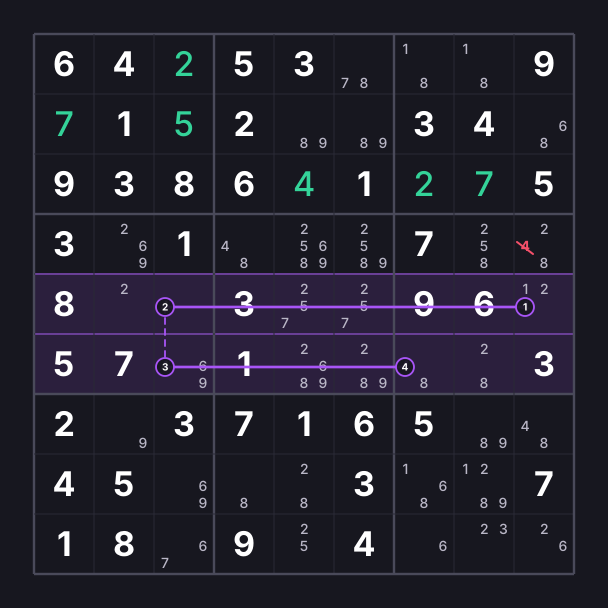
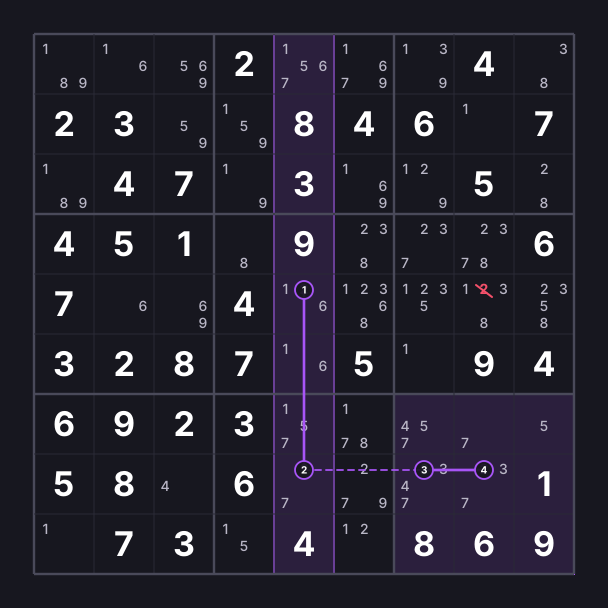
Learn these first
- X-WingA digit is stuck in the same two columns in two different rows, making a rectangle.
- Locked Candidates (general form)Sometimes all the spots for a digit inside one group also sit inside a second group.
Related single-digit patterns
- X-ColoringColouring with an extra step.
- 2-String KitePick a digit.
- 3D MedusaColouring spread across every digit at once, not just one.
- Empty RectangleIn one box, all the homes for a digit sit in one row and one column.
- Multi-ColoringColouring marks a digit's spots in two shades.
How often does it come up?
Our rough estimate: common as a family. Its named specializations are how most solvers actually meet it.